Furnace Repair in Arcadia
The gist: Call Arcadia Mitsubishi HVAC to repair a gas furnace or dual-fuel system anywhere in Arcadia and 91007, common in Lower Rancho and Peacock Village ranch homes, and we diagnose ignition, inducer, and high-limit faults by control-board flash code before quoting. A flame-sensor or igniter fix runs about $150 to $400; book online for same-week heat.
The cheat sheet
- Flash-code diagnosis: ignition lockout, pressure switch, open high-limit
- Common parts: hot-surface igniter, flame sensor, inducer motor, gas valve
- Flame sensor and igniter repairs on the low end of cost
- Furnace replacement typically $3,000 to $7,500 in 2026 SoCal
- California Ultra-Low NOx models common locally
- Heat exchanger safety checks; we red-tag a cracked exchanger
- Open 6:30am-8pm weekdays, 8am-5pm weekends; ZIPs 91006, 91007, 91066, 91077
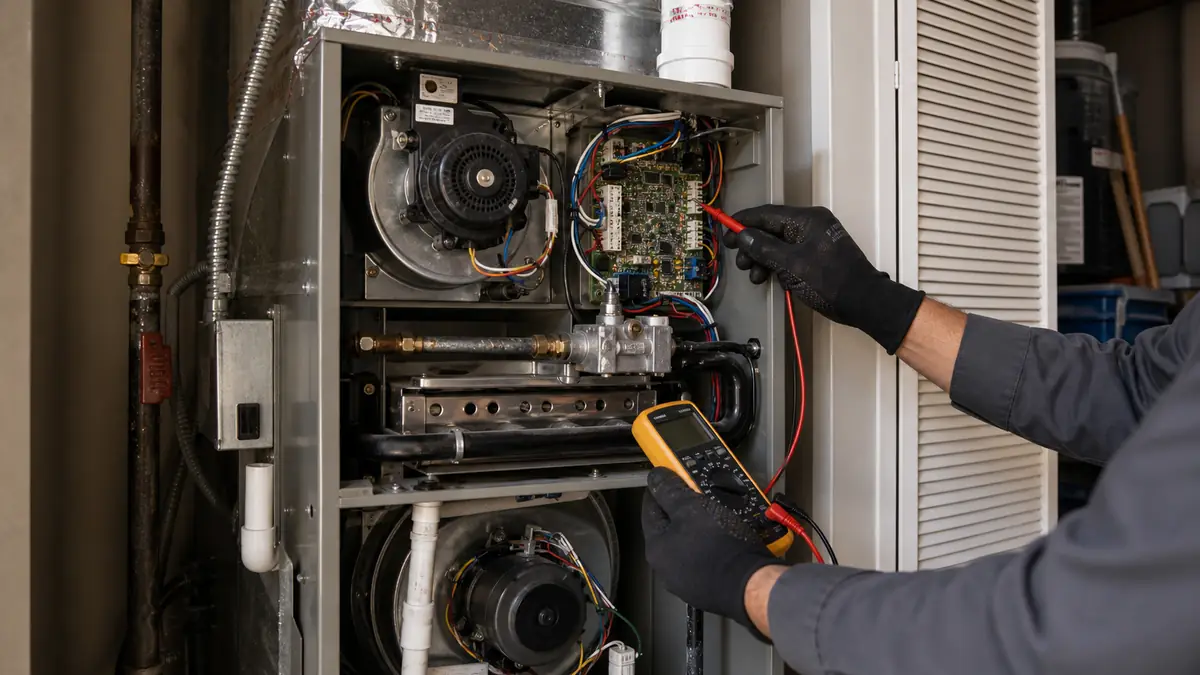
Why is the furnace not lighting?
Most no-heat calls trace to the ignition train. A hot-surface igniter cracks and stops glowing, a flame sensor gets coated and fails to prove flame, or the inducer and pressure switch do not confirm draft. The control board counts retries and then locks out, flashing a code through the sight-glass LED. On a Trane integrated furnace control, 2 flashes means a hard ignition lockout, 3 a pressure-switch fault, 4 an open high-limit, 8 weak flame sense, and 9 an igniter-circuit problem. On a Carrier board the same faults read as numeric codes - 14 ignition lockout, 31 pressure switch, 13 or 33 limit, 34 ignition proving, 24 a blown control fuse. We count or read those codes and test the implicated part instead of guessing.
| Symptom | Likely cause / first check | Code (Trane / Carrier) | Cost lane |
|---|---|---|---|
| Ignites, then drops out after seconds | Dirty flame sensor or weak igniter losing flame proof | 8 flash / 34 | $150 - $400 |
| Clicks, no ignition, hard lockout | Cracked igniter, no gas, or gas-valve circuit | 2 flash / 14 | $200 - $600 |
| Runs then trips on overheat | Open high-limit from low airflow or a dirty filter | 4 flash / 13, 33 | $120 - $450 |
| No draft, inducer silent or noisy | Inducer motor or pressure switch not closing | 3 flash / 31 | $300 - $900 |
| Blower runs but no warm air | Gas valve circuit or ECM blower fault | 7 flash / 24, 45 | $300 - $1,200 |
| Rollout trips repeatedly | Heat exchanger inspection (carbon-monoxide safety) | - / 26 | Diagnose first |
How does an Arcadia furnace repair actually go?
A no-heat furnace visit in Arcadia follows a set checklist, top to bottom, precisely so no part leaves the truck on a hunch. Here is how the call unfolds:
- Pull the door, read the control-board LED flash count or numeric code, and note the lockout history before resetting anything.
- Confirm 24V and line voltage, check the filter and static pressure, and verify the inducer pulls a clean draft so the pressure switch can close.
- Test the implicated part: microamp draw on the flame sensor (a healthy reading is roughly 2 to 6 microamps), resistance and glow on the hot-surface igniter, continuity on the limit and rollout switches, and the gas valve circuit.
- Inspect the heat exchanger with a light and, when a rollout or repeat-overheat pattern points to it, a combustion-gas check - a cracked exchanger gets red-tagged, not patched.
- Replace the failed component, cycle the furnace through a full ignition-to-blower sequence, and recheck flame sense and temperature rise against the rating-plate range before we leave heat running.
Which furnaces do you repair in Arcadia?
Most Arcadia ranch homes run a single-stage 80 percent gas furnace, and that is the bulk of our no-heat work. We service the common families across all three brands so a dual-fuel or replaced system has a sensible path. On Trane that spans the 80 percent XR80, XL80, and XV80 tier through the high-efficiency S9V2 two-stage and XC95m modulating units; the communicating ones surface plain-language alerts on an XL824 or XL850 thermostat. On Carrier it covers the 58-series 80 percent furnaces up through the 59TN and 59MN7 condensing line, with California Ultra-Low NOx variants such as the 59CU5 that matter under local emissions rules. When the furnace is the gas half of a dual-fuel pairing, we wire its changeover with the Mitsubishi heat pump so the burner only fires below the balance point.
Does an Arcadia home even need a high-efficiency furnace?
Heating is the smaller half of the load here. Zone 9 winters are mild, so an 80 percent AFUE furnace is frequently adequate and is what many Arcadia ranch homes already run. A condensing 90-plus percent furnace pays back faster in cold climates than ours. If your gas furnace is failing and you heat only a handful of weeks a year, this is the moment to weigh a Mitsubishi heat pump conversion against another gas repair.
What does furnace repair cost in Arcadia, and why?
The number depends entirely on which part failed, and the diagnostic ($79 to $200 in 2026 SoCal, often credited toward the repair) tells us which. The cheap end is the ignition train: a flame-sensor clean or hot-surface igniter runs about $150 to $400 because the part is inexpensive and most of the cost is the trip and labor. A pressure switch or inducer motor sits in the $300 to $900 band. A gas valve or an integrated control board climbs to $400 to $1,200, and a variable-speed ECM blower module can reach $450 to $2,300. A full furnace replacement runs $3,000 to $7,500, with the high end being a modulating 96 to 98 percent unit and the value end an 80 percent single-stage that suits most Arcadia homes. Two cost drivers push these up locally: SoCal labor rates and the California Ultra-Low NOx requirement that limits which models we can install.
When should a furnace be replaced instead of repaired?
Two situations force the call. A cracked or rusted-through heat exchanger is a carbon-monoxide safety issue we will not patch. The other is purely financial: once an aging furnace has piled up repair bills that creep past roughly half what a new unit costs, you are throwing good money after bad - so if your furnace has cleared 15 years and now wants a gas valve plus an inducer, the replacement column usually wins, and in mild Arcadia a heat pump can edge out a new furnace altogether. We show both paths with real numbers.
What is different about furnaces in Arcadia homes?
Three local wrinkles shape the work. First, the housing stock: the mid-century ranch homes across Lower Rancho and Peacock Village were built with the furnace in a hall closet or the attic, and the original 80 percent units in them are now decades old and often still serviceable but parts-limited. Second, the climate: Zone 9 heating runs only a handful of weeks, so a struggling furnace can hide a fault for months until the first cold San Gabriel foothill morning forces the call - which is why a pre-winter check pays off. Third, the foothill dust: Santa Ana season pulls grit into returns, and a clogged filter starving airflow is the single most common nuisance trip we see, faking a major fault that a clean filter clears. The newer teardown rebuilds on the larger Upper Rancho and Santa Anita Oaks lots more often arrive ready for a heat-pump conversion than another gas repair.
How do you keep a foothill furnace reliable?
Filters first. A clogged filter starves airflow and trips the high-limit, the single most common nuisance fault. Beyond that, an annual check of the flame sensor, inducer, and safety switches before the first cold snap catches the failures that otherwise strand you on a January morning. Our maintenance calendar lays out the timing, and the high-bills page covers why a struggling furnace burns extra gas.
Common questions about furnace repair
My Arcadia furnace ignites then shuts off after a few seconds. Why?
That is usually a dirty flame sensor or a weak hot-surface igniter losing flame proof. On many control boards it shows as a short-cycle lockout after a set number of retries - a Trane integrated furnace control flashes 8 for low flame sense, Carrier shows code 34 for ignition proving failure. Cleaning or replacing the flame sensor is a cheap fix; a cracked igniter is a modest part.
Do you repair gas furnaces if I am switching to a Mitsubishi heat pump anyway?
Yes. Plenty of Lower Rancho ranch homes still run a gas furnace and want it limping through one more winter while they plan an electrification. We repair it honestly, and if the heat exchanger is compromised we tell you to stop using it - that is a safety line, not an upsell.
What does a furnace repair cost in Arcadia?
A flame sensor clean or igniter swap runs about $150 to $400; an inducer motor or gas valve lands roughly $300 to $900; a full furnace replacement runs $3,000 to $7,500 in 2026 SoCal, with California Ultra-Low NOx models common. We give you the cost lane after reading the flash code, and the diagnostic is often credited toward the repair.
Is an 80 percent furnace fine for Arcadia, or do I need 96 percent?
In mild Zone 9, an 80 percent furnace is frequently adequate and is common locally. A condensing 90-plus percent furnace saves more in cold climates than ours. If you heat rarely, the payback on high-efficiency gas is slow, so a heat pump often makes more sense for Arcadia.
How long does a no-heat furnace repair take in Arcadia?
Most no-heat calls are a single same-week visit. Reading the flash code, testing the suspect part, and swapping a flame sensor, igniter, pressure switch, or inducer is typically an hour or two on site. A gas valve or control board may need a part order, but stocked igniters and sensors usually get heat back the same day.
Why does my furnace overheat and trip the limit on a cold Arcadia morning?
Almost always low airflow. A clogged filter, a collapsed return, or a dirty blower wheel starves the heat exchanger of air, so it overheats and the high-limit opens - Trane flashes 4, Carrier shows code 13 or 33. We check filter and static pressure first, since a $30 filter often clears what looks like a major fault.
Do you handle dual-fuel systems that pair a furnace with a Mitsubishi heat pump?
Yes. A dual-fuel setup runs the Mitsubishi heat pump for mild Arcadia days and the gas furnace only on the coldest mornings, switching at a balance point we set. We service both halves, wire the changeover correctly, and verify the furnace stages in only when the heat pump needs backup.