Mitsubishi Fault Codes Explained for Arcadia
The gist: Arcadia Mitsubishi HVAC decodes Mitsubishi P, E, and U fault codes for homeowners across Arcadia and 91006 - P-codes point at indoor sensors and drains, E-codes at communication, U-codes at the outdoor compressor and inverter. Read your code below, then call (213) 772-2088 or book online for a real diagnosis.
The cheat sheet
- Codes read from the green LED blink, wired controller, or kumo cloud app
- P-codes: indoor sensors, drains, freeze protection
- E-codes: indoor-outdoor and remote-controller communication
- U-codes: outdoor compressor, inverter, fan motor, voltage
- Drain fault (P4/P5) repairs typically $150 to $450 in 2026 SoCal
- Inverter board / compressor faults $400 to $3,500
- Open 6:30am-8pm weekdays, 8am-5pm weekends; ZIPs 91006, 91007, 91066, 91077
How do I read a Mitsubishi code?
Your unit tells you in one of three ways. The indoor head flashes the green operation LED in a counted pattern; a wired PAR controller or MHK2 shows an alphanumeric code; and the kumo cloud app logs it with a timestamp. Note that a slow, steady green blink is usually normal - the system in defrost or heat preparation. It is the rapid or patterned blink, often paired with the timer LED, that is flashing an actual P, E, U, or F code worth writing down before you call.
What do the common codes mean?
The codes below are the ones we see most on Arcadia mini-splits. Use it to understand what your unit is reporting; the cost lanes are typical 2026 Southern California ranges and a real diagnosis confirms the part.
| Code | Likely cause / first check | Cost lane |
|---|---|---|
| P4 / P5 | Drain float or pump; clogged condensate drain | $150 - $450 |
| P6 | Freeze / overheat protection; dirty filter or low airflow | $120 - $450 |
| P1 / P2 / P9 | Room or pipe thermistor open/short | $150 - $400 |
| E6 / E7 / E8 / E9 | Indoor-outdoor communication; S1/S2/S3 wiring | $150 - $600 |
| U7 / P8 | Low refrigerant / abnormal pipe temp; flare leak | $225 - $1,500 |
| U2 / U3 | High discharge temp or discharge thermistor | $300 - $1,200 |
| U6 / UF / UP | Compressor overcurrent / inverter; board or compressor | $400 - $3,500 |
| U8 | Outdoor DC fan motor fault | $300 - $1,200 |
How does a tech work a code from there?
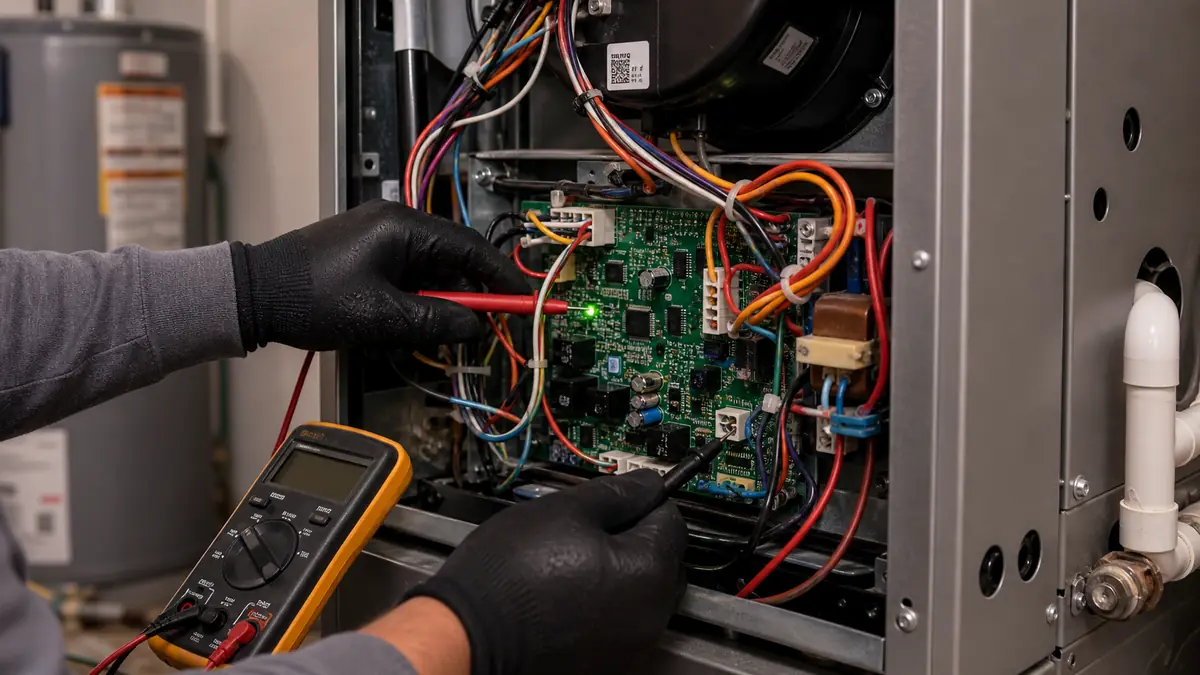
Reading the code is the start, not the answer - the same code can have more than one root. Take a U7: it flags low discharge superheat, which usually means low refrigerant, so we put gauges on the ports, confirm the suction pressure and superheat, then bring the line up on nitrogen and run an electronic detector down each flare joint until the leak shows itself - all before a drop of refrigerant goes back in. A P5 sends us to the drain pan and pump to separate a clog from a dead pump. An E6 through E9 sends us to the S1/S2/S3 terminals to re-land and meter the inter-unit wiring before condemning a board. A U6 needs the inverter board and compressor windings checked under load. The point is that the code narrows the search; the instruments name the part.
What can I safely check before calling?
A few things are fair game for a homeowner, and a clear line is not. Safely: read and write down the exact code from the LED blink, the wired controller, or the kumo cloud app; clean or wash the filter, which alone can clear a P6 airflow trip; and make sure the outdoor unit is clear of leaves and debris. One power cycle at the breaker is reasonable to clear a transient soft fault. Beyond that, stop - opening the cabinet to probe an inverter board, touching the S1/S2/S3 terminals live, or adding refrigerant are pro tasks with shock, charge, and warranty consequences. A code that returns after one reset is the unit telling you it needs a real diagnosis, not another reset.
Which codes are urgent, and which can wait?
A drain code (P4, P5) means the unit stopped cooling to avoid overflowing - annoying but rarely damaging, and an affordable fix. A communication E-code is often a loose wire, also not catastrophic. But a recurring U2, U6 compressor-overcurrent code, or U7 involves the compressor or inverter and a refrigerant or electrical problem; clearing it repeatedly without a diagnosis risks a much bigger failure. If you have a U-code that keeps coming back, stop resetting and get it looked at. Compare your symptom against the water-leaking page if you also see moisture, or the high-bills page if it just runs long.
Is my unit still under warranty?
This changes who you should call. If your Mitsubishi system is within its parts warranty - often 10 years on the compressor when registered - a covered component like an inverter board or compressor is best routed through a Mitsubishi authorized contractor so the claim is honored. We will check the registration and tell you plainly, then handle the out-of-warranty repairs, second opinions, and the foothill-specific work the big outfits skip.
Common questions about fault codes
Where do I read the fault code on my Mitsubishi?
Three places. The indoor unit flashes the green operation LED in a pattern, the wired controller (PAR or MHK2) shows an alphanumeric code, and the kumo cloud app logs it. A slow steady green blink is usually normal defrost or heat-prep; a rapid or patterned blink with the timer LED is an error to read.
What does a P5 code mean on my mini-split?
P5 is a drain pump abnormal or high-condensate-level fault. The unit detected water it cannot clear, so it protects itself by stopping cooling. In Arcadia that is usually a clogged condensate drain or a failed pump - a common foothill-summer call, and often an affordable fix once we clear or replace the pump.
Are U-codes more serious than P-codes?
Generally, yes. P-codes point at indoor sensors and protection, E-codes at communication, but U-codes flag the outdoor compressor and inverter - U2 high discharge temp, U6 compressor overcurrent, U8 outdoor fan motor. Those can mean a board or compressor, the pricier repairs, so they warrant a careful on-site diagnosis.
Can I clear a code by resetting the breaker?
A power cycle clears a soft fault, and if the unit runs normally afterward the trigger may have been transient. But a code that returns is telling you something real - resetting repeatedly to mask a U6 or P8 just delays a diagnosis and can let a small problem damage the compressor.