Mitsubishi U6 Code in Arcadia: Compressor Overcurrent
The gist: A Mitsubishi U6 code in Arcadia, CA (ZIP 91006) means compressor overcurrent - the inverter board sensed too much current and stopped the outdoor unit to protect the compressor. Call (213) 772-2088 or book online and we will meter it on site to tell heat and a dirty coil from a failing inverter board or compressor.
The cheat sheet
- U6 = compressor overcurrent, sensed by the outdoor inverter board
- U-family codes live on the condenser, not the indoor head
- Common parts: inverter/IPM power board, DC inverter compressor, outdoor fan motor
- Inverter or IPM board: about $400 to $2,000 in 2026 Arcadia
- Compressor replacement: roughly $1,200 to $3,500
- A coil-heat U6 can clear for the price of a cleaning visit
- Open 6:30am-8pm weekdays, 8am-5pm weekends; ZIPs 91006, 91007, 91066, 91077
What does a U6 code mean on a Mitsubishi?
Think of the U6 as the outdoor unit's circuit breaker for its own compressor. Every Mitsubishi inverter system runs the compressor through a power module on the outdoor control board, and that module constantly watches how much current the compressor pulls. When the current climbs past the safe ceiling, the board reads it as an overcurrent condition, stops the compressor, and posts U6. The letter is the tell: P-codes are indoor sensors and drains, E-codes are communication between the head and the condenser, but U-codes belong to the outdoor compressor, inverter, and fan circuit. So a U6 is the system telling you the heart of the machine is drawing more power than it should - and it has shut down rather than burn something out. The job from there is to learn why the current went high, because three very different problems all wear the same code.
Why does my Mitsubishi throw U6 in Arcadia?
Arcadia sits in the San Gabriel Mountains foothills, and that geography is hard on condensers. The foothill bowl traps afternoon heat against the mountains, so on a Zone 9 summer day a unit in Highland Oaks or Santa Anita Oaks can be rejecting heat into 100-plus-degree air right when it is working hardest. A compressor that has to push against a hot, high-pressure head pulls more amps, and a coil caked with the oak pollen and dust these older neighborhoods are full of makes it worse by smothering the very surface that is supposed to shed that heat. Add the local housing pattern - long runs to outdoor units tucked beside Spanish-revival walls or wedged against a mansionized rebuild where airflow is pinched - and you have a recipe for high discharge pressure and the overcurrent that follows. The other two causes are mechanical: an aging compressor whose windings or bearings are degrading and a failing inverter or IPM power board that misreads or mishandles the current. Heat and dirt are the cheap end; the compressor is the expensive end.
How do you diagnose a U6 on site?
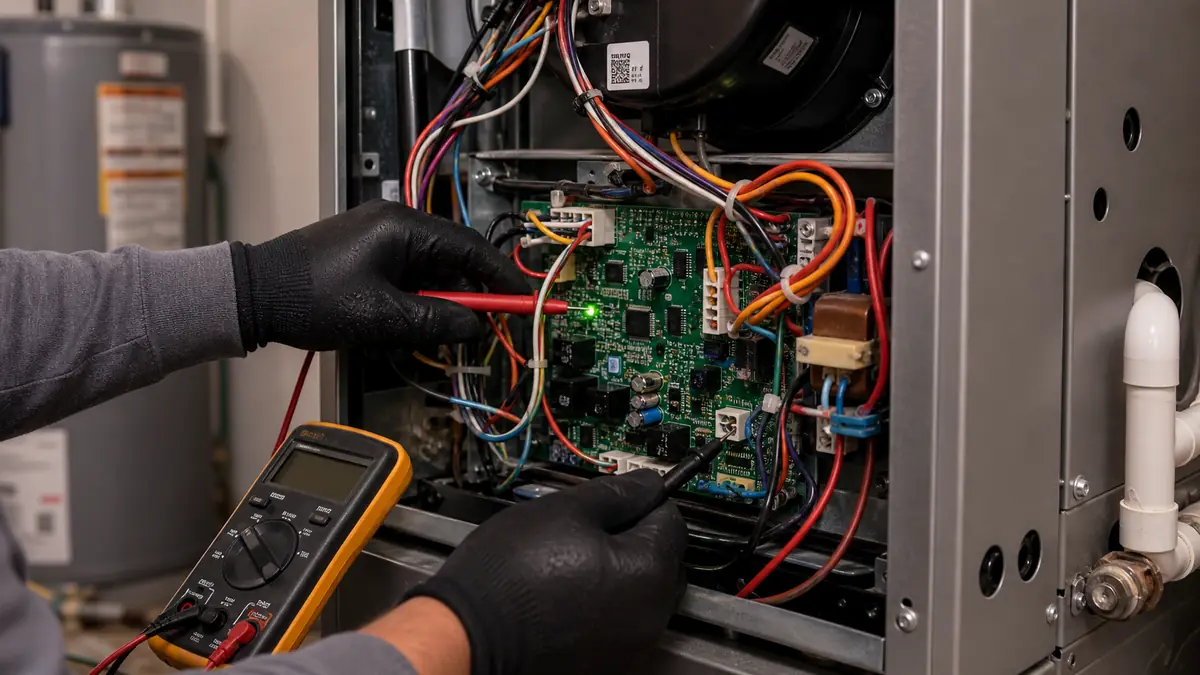
We work U6 from the cheap, likely causes outward so you are not paying for parts you do not need. First we read the full fault history from the wired controller or the kumo cloud log, because a U6 that always lands on the hottest part of the afternoon points one way and a U6 at startup on a mild morning points another. Then the meter comes out: a clamp ammeter on the compressor leads tells us the actual draw against the model's rated amps, and gauges on the service ports give us suction and discharge pressure so we can see whether the unit is fighting a high head from heat and a dirty coil. If pressures and amps are sane, we move to the board - testing the IPM power module and the DC bus for a driver fault, and checking the outdoor fan motor, since a dead fan lets pressure and current spike. Last, we ohm out the compressor windings and check for a shorted or grounded winding. That sequence - logs, amps, pressures, board, then compressor - separates a $150 coil cleaning from a board swap from a compressor change without guessing.
What can I safely check before calling?
A homeowner can do real good here without opening anything dangerous. Kill power to the outdoor unit at the disconnect, then gently rinse the outdoor coil from the inside out with a garden hose to wash off the foothill pollen and dust - a smothered coil is the most common cheap cause of a heat-driven U6. Clear leaves, oak debris, and any planter or fence that has crept within a couple of feet of the condenser and is choking its airflow. Confirm the disconnect and breaker are fully on, since a unit running on a dropped leg can read as overcurrent. After that, restore power and let it try once. That is the line. Do not open the condenser cabinet, do not probe the inverter board, and do not add refrigerant - those are live high-voltage and pressurized-system tasks with shock and warranty consequences. If U6 comes back after one clean coil and one reset, it is no longer an airflow problem, and the next move is a meter, not another reset.
When is a U6 urgent, and what will it cost?
U6 is one of the codes worth respecting. A single U6 on a brutally hot afternoon that clears after a coil rinse is not an emergency - it was heat. But a U6 that keeps returning is the inverter board telling you the compressor is pulling dangerous current, and every reset past it forces that current through the compressor again. That is how a repairable board fault becomes a seized compressor. Cost-wise, a coil-and-airflow U6 clears for the price of a cleaning visit. A failed inverter or IPM power board runs about $400 to $2,000 in 2026 Arcadia pricing. A compressor that is genuinely failing runs roughly $1,200 to $3,500, and on a condenser past twelve years that number pushes the conversation toward replacement. We give you the repair-versus-replace math for your exact unit, and where a new system makes sense we size it with a Manual J - see the sizing guide. For the full code map, the Arcadia Mitsubishi fault-code reference covers the rest, and our AC and mini-split repair page explains how a visit works.
Common questions about the U6 code
What does a U6 code mean on a Mitsubishi?
U6 means compressor overcurrent. The inverter board measured more current to the compressor than it allows and shut the outdoor unit down to protect itself. The root cause is usually a tired compressor, an inverter or IPM power-board fault, or a condenser running too hot. It is an outdoor, U-family fault, so it points at the condenser, not the indoor head.
Can I fix a Mitsubishi U6 code myself?
No - U6 is a pro repair. You can safely rinse the outdoor coil, clear leaf litter, and confirm the disconnect is on, which sometimes clears a heat-driven U6. Beyond that the diagnosis needs clamp-meter amp readings, IPM and compressor-winding tests, and the cabinet open on a live high-voltage circuit. Adding refrigerant or swapping a board is not a homeowner job.
How much does a Mitsubishi U6 repair cost in Arcadia?
It depends on the part. If the U6 traces to a failed inverter or IPM power board, expect about $400 to $2,000 in 2026 Arcadia pricing. If the compressor itself is drawing high amps and failing, a replacement runs roughly $1,200 to $3,500. A heat-driven U6 from a dirty coil can clear for the price of a cleaning visit.
Is it safe to keep running a unit showing U6?
No. Resetting past a U6 forces high current through a compressor the board already flagged, and that can turn a board-level fix into a dead compressor. If U6 returns after one coil cleaning and reset, stop power-cycling it and book a diagnosis. The protection is doing its job - overriding it repeatedly is how a $400 repair becomes a $3,000 one.