Mitsubishi P8 Code in Arcadia: Pipe-Temperature Fault
The gist: A Mitsubishi P8 code in Arcadia, CA (ZIP 91007) means abnormal pipe temperature - the coil sensors read a value the controller does not expect, most often a slow refrigerant leak at a flare joint. Call (213) 772-2088 or book online and we will leak-test the system before we add any refrigerant back into it.
The cheat sheet
- P8 = abnormal pipe temperature read by the coil thermistors
- Most common cause: low refrigerant from a flare-joint leak
- Other causes: stuck LEV/EEV valve, failed pipe sensor (TH2/TH5), wiring
- Leak repair plus recharge: about $225 to $1,500 in 2026 Arcadia
- A stuck valve or sensor sits at the lower end of that range
- We find and fix the leak before adding refrigerant
- Open 6:30am-8pm weekdays, 8am-5pm weekends; ZIPs 91006, 91007, 91066, 91077
What is the Mitsubishi P8 code telling me?
P8 is a pipe-temperature fault. Mitsubishi mini-splits carry small thermistors clamped to the refrigerant pipes on the indoor coil - the TH2 and TH5 sensors - and the controller compares what they read against what it expects for the mode the unit is running. In cooling, the coil should be a certain band of cold; in heating, a certain band of warm. When the measured pipe temperature drifts outside that window, the controller raises P8 and stops, because an out-of-range coil usually means something is wrong with the refrigerant doing the cooling or the valve metering it. Unlike the U-codes that live out at the compressor, P8 is an indoor-side protection fault, which is why the first place we look is the coil, the metering valve, and the charge rather than the condenser. The code is honest but broad - it tells you the pipe temperature is wrong, not yet why.
Why do Arcadia mini-splits leak refrigerant and trip P8?
The single most common cause of P8 is a low charge, and on ductless systems the charge almost always leaks from a flare joint. A flare is a hand-made connection - the installer cones the copper line and torques it to a fitting - and it lives or dies on that torque and a clean seam. Arcadia's housing stock works against those joints in a specific way. The neighborhoods here run from mid-century ranch to Spanish and Mediterranean revival estates to the wave of newer mansionized rebuilds, and ductless heads have been retrofitted into all of them, often with line sets snaking through hot attics and along sun-baked exterior walls in Upper Rancho and Lower Rancho. Years of foothill thermal cycling - cold refrigerant inside, 100-degree afternoons outside - work-harden the copper and let a flare weep slowly. A retrofit done in a hurry during a remodel can leave a flare a quarter-turn shy of seated, and that joint will sweat refrigerant for a year before the charge falls far enough to trip P8. The result is the classic Arcadia P8 call: a unit that cooled fine last summer and now throws P8 on the hottest days because the charge has quietly drained.
How do you track down the cause of a P8?
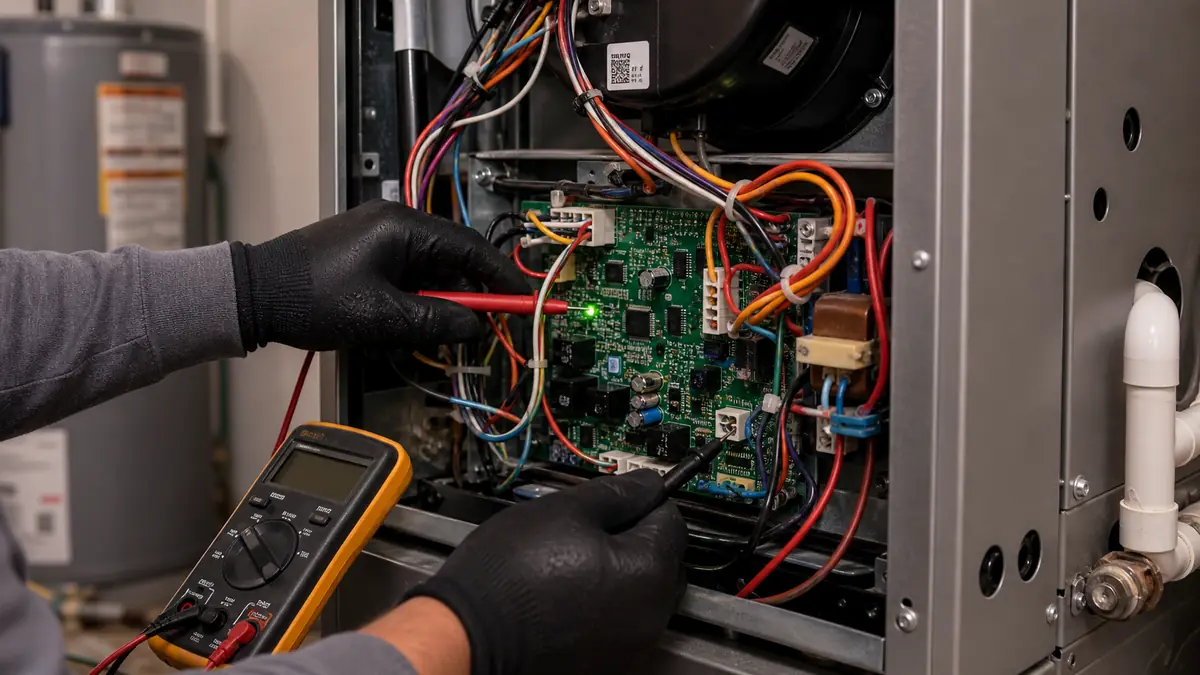
A P8 is a leak hunt done in order, not a refrigerant top-off. We start at the controller and kumo cloud log to confirm it is genuinely P8 and to see whether it trips in cooling, heating, or both. Then gauges go on the service ports to read suction and discharge pressure and calculate superheat and subcooling - the numbers that say plainly whether the system is undercharged. If it is low, we do not just add gas. We pressurize the lines with dry nitrogen, walk an electronic leak detector down every flare and the indoor and outdoor coils, and confirm the exact joint that is weeping, because a recharge into a leaking system is money you watch escape. While we are there we verify the pipe thermistors read correctly against an actual thermometer and check that the LEV - the linear expansion valve that meters refrigerant into the coil - is stepping open and closed instead of sticking, since a stuck LEV mimics a charge problem. Only once the leak is repaired, the joint re-flared and torqued, and the system pulled into a deep vacuum do we weigh in the correct charge by the unit's spec. That order - confirm low, find the leak, fix it, then recharge by weight - is the difference between a real repair and a refill that fails again by next season.
What can a homeowner safely check first?
P8 leaves homeowners less to do safely than an airflow code, because the heart of it is the sealed refrigerant circuit, and that is firmly off-limits. What you can do: write down the exact code from the wired controller or kumo cloud app, note whether it trips in cooling or heating and on which head, and check the simple airflow basics - a filthy filter or a blocked indoor coil can push pipe temperatures out of range too, so wash the filter and make sure return airflow is not blocked by furniture or a closed louver. Make sure the outdoor unit is clear so it can shed heat normally. A single reset at the breaker is fine to see whether the code was a transient. But do not open the line-set covers, do not touch the flare nuts, and absolutely do not buy a recharge can and try to add refrigerant - a sealed system is a closed, weighed charge, and DIY top-offs both mask the leak and overcharge the unit, which can damage the compressor. If P8 returns, the next step is gauges and a leak detector, not another reset.
How urgent is a P8, and what does the fix cost?
A P8 is not the drop-everything emergency a gas-furnace safety fault is, but it should not sit either. A slow flare leak only gets worse: the lower the charge falls, the harder the compressor works with too little refrigerant for cooling and lubrication, which over a season can shorten its life - and the more refrigerant has already escaped into the air. So the urgency is about protecting the compressor and stopping the bleed, not about safety. On cost, a leak repair plus a proper recharge runs about $225 to $1,500 in 2026 Arcadia pricing, driven by where the leak hides and how much refrigerant the system holds; a stuck LEV valve or a failed pipe thermistor sits at the lower end of that band. If the leak is at an accessible flare, it is a same-visit fix; if it is buried in a coil, the math can tilt toward coil or system replacement, and we will lay that out honestly. For the full set of codes see the Arcadia fault-code reference, and if you are also seeing drips, compare the water-leaking page. When a leak repair is the answer, our AC and mini-split repair page walks through the visit.
Common questions about the P8 code
What does a P8 code mean on a Mitsubishi mini-split?
P8 is an abnormal pipe-temperature fault. The pipe thermistors on the indoor coil are reading a temperature the controller does not expect for the mode it is running, which most often means the refrigerant charge is off - usually a slow leak at a flare joint. It can also be a stuck LEV/EEV metering valve, a failed pipe sensor, or on some wall units a wiring or communication issue.
Does a P8 code always mean a refrigerant leak?
Not always, but a leak is the most common cause. Refrigerant carries the heat, so when the charge drops the coil temperatures drift out of range and the pipe thermistors trip P8. The other suspects are a stuck linear expansion valve that is metering wrong, a pipe thermistor that has failed open or shorted, and miswired or loose inter-unit terminals. A proper diagnosis tells these apart before anyone adds refrigerant.
How much does a Mitsubishi P8 repair cost in Arcadia?
A refrigerant leak repair plus recharge runs about $225 to $1,500 in 2026 Arcadia pricing, depending on where the leak is and how much refrigerant the system holds. A stuck LEV metering valve or a failed pipe thermistor sits at the lower end of that range. We find and fix the leak before recharging, since pumping refrigerant into a leaking system just pays to lose it again.
Can I keep running my mini-split with a P8 code?
It is better not to. A P8 from a low charge means the compressor may be running with too little refrigerant for cooling and lubrication, and running it that way can shorten compressor life. The unit will often shut down on its own anyway. Note the code, stop forcing it back on, and book a leak diagnosis - the longer a flare leak runs, the more refrigerant and money it costs.